Friday, October 3, 2014

Costuming the Author, and the Reader

Fall is in the air, and Halloween is coming!  Already I'm seeing advertisements for masquerades and costume contests.  Marissa has posted in the past about the types of costumes our nineteenth century lads and lasses might have worn.  They enjoyed playing dress up.  Today’s author of nineteenth century romance is not immune, and, I'm betting, neither is her readers.  So, to get you thinking about how you might design your own outfit, here are some examples from my sister romance authors.

You can, of course, pay a seamstress to design you a costume.  I am so envious of these amazing gowns worn by the talented Collette Cameron and the wonderful Ella Quinn.  Looking good, ladies!


Or, you might be handy with a sewing machine yourself.  Several patterns are available these days.  Immediately below is acclaimed Regency author April Kihlstrom in a fetching red gown. And farther down is Golden Heart Award winner Kristi Ann Hunter in one she and her mother made together.

Then again, you might find a costume awaiting you in your favorite thrift store.  Doesn’t the delightful Georgie Lee look festive in her frugal find? 


Finally, some fashions from earlier years can be readily adapted to “faux Regency.”  When I wear this one with the flocked orange roses next to Marissa in her seamstress’s creation, I always say I must be the poor relation.  J


But then again, I have another costume I much prefer.  That's Sir Reginald with the regal Marjorie Allen.  


What do you think?  Any of these approaches appeal to you?

Many thanks to my models, most of whom are members of my beloved Beau Monde Chapter of Romance Writers of America.TM


Tuesday, September 30, 2014

Girls and World War I, Part 3: Getting Down and Dirty (in the Garden)

With the clarion call to American women to save food at home so that the starving of Europe and the troops fighting the Kaiser could be fed, 1917 could be called the year of the canning jar...sort of.

It started in the spring. American women were exhorted to plant gardens and preserve their crops, and by July, the women’s magazines blossomed with advice: July’s McCall’s article “Uncle Sam’s Kitchen Brigade” gave a detailed list of how each type of garden bounty could be canned, both fruit (apricots, plums, berries, and cherries) and vegetables (bean, peppers, asparagus, cabbage spinach, cauliflower, carrots, and beets).

The Independent featured an article on dehydrating foods in June as did The Ladies’ World Magazine in August which suggested dehydrating foods--including leafy greens like spinach-- to preserve them (as the lady above is doing, with wire mesh trays and a house fan!) for a very practical reason: because of the success of the canning campaign, there was a national shortage of canning jars! The Ladies’ Home Journal included an article about “the new containers”, primarily different types of coated paper--the forerunner of our paper milk and juice cartons today.


In addition to all the encouragement
to can, preserve, and dry, American women were also encouraged to change the way their families ate. Based on the number of articles and recipes published about salads this summer (in Women’s World and The Modern Priscilla in particular), I have to wonder if anyone actually ate them before 1917.  The salad was a somewhat different creature from today’s greens and chopped veggies: it tended more to be a collection of foods mixed together and served cold, thereby saving cooking fuel and using up not only the garden’s bounty but also anything else that happened to be lurking in the icebox.  How can you resist a tasty Baked Bean salad, presented by such a fetching young lady?

Friday, September 26, 2014

The Longitude and Latitude of St. Petersburgh

Political cartoons have been around a long time.  One of the most famous caricaturists of nineteenth century England was George Cruikshank.  Below is one of my favorites of his, dubbed the Longitude and Latitude of St. Petersburgh.


Why, you might ask?

The scene is Almack’s, that exclusive ladies' club of London.  The gentlemen all sport the requisite knee breeches and white stockings.  The ladies are in their finery, ostrich plumes waving.  And every eye is turned to the couple dancing to the music of the orchestra in the box at the upper left.  That couple, it is said, is Prince Pyotr Borisovich Kozlovsky of Russia and the Countess Lieven (later Princess). As you can see, they make quite a pair. 

It wasn't only their looks that contrasted.  The prince was from one of Europe’s oldest royal families, but wasn't particular bright or ambitious.  He was a bit of a womanizer and somewhat associated with literary circles, mostly through connections, not achievements.  He entered the diplomatic corps, served for a time in Sardinia, and was a part of the Congress of Vienna.  As wide as he was tall, he visited England with the Russian delegation in 1812 and seems to have paid court to many a lady, married or not.  The novelist Maria Edgeworth is credited as saying of him, “If he throws himself at my feet, he will never be able to get up again.” 

Dorothea von Lieven, on the other hand, also came from a Russian royal family and was wife to the Russian ambassador in London in 1812.  She was everything the prince was not--tall, slender, intelligent, and ambitious.  Her social skills made her invitations among the most sought after in the land, giving her husband’s career a major boost.  She was the first foreigner to be made a patroness of Almack’s and is said to have introduced the waltz to England.  Somehow, I doubt she saw herself dancing it with Kozlovsky and certainly not to be ridiculed in cartoon afterward.

The prince, however, thought the whole thing hilarious.  He would.

Tuesday, September 23, 2014

Inspiration is Where You Find It

Much to my surprise, I find that I’m working on another Regency-set story. It’s made for a somewhat confusing existence—I’m still working on my WWI story as well, and working on two very different stories set in two very different eras means my writing room is even more ridiculously cluttered with piles of open reference books and scraps of paper scrawled with notes than usual. I also got attacked by a science fiction romance story idea earlier this summer, but we’re not even going to go there just now...

Part of the reason I think this new story grabbed me so hard—I’d actually been toying with it in a desultory fashion for a couple of years—is a couple of purchases I made on-line. Just for fun, I periodically do an eBay search on portrait miniatures—those exquisite little portraits so popular in the early nineteenth century before the invention of photography. Now, to be honest, a lot of the ones I’ve seen are just...well, homely—not to mention completely out of my price range.

But on that day, I found one that set me reeling, because I knew that face—it was the hero of my Regency story. Moreover, it was ridiculously affordable...so you’d better believe I snapped it up! The ruler is there for scale; isn’t it exquisite?


Well, that just whet my appetite. And literally just days later, when looking again, I found another one—also affordable, also exquisite...and there was my heroine, Annabel:


And after that, the floodgate opened. Annabel and Quin, now real people (you know what I mean!) would not leave me alone, and the vague wisps of story and character I had began to firm up into real characters and a real plot. I’m not very far—this is going to be a BIG story with a lot of characters and various goings-on. But having these likenesses of people who actually lived in the early 19th century...well, I’m hooked on writing it.

But trying to live in both 1810 AND 1917 is still a pain in the you-know-what.

Friday, September 19, 2014

Your Best Guides to London

I've been to London, but oh how I want to go back!  It's a city steeped in history, in drama.  I swear excitement lives in the very air.  Maybe it's because I’m walking down the streets my characters walked, seeing sights that existed before they were even born.  Despite all my critique partners admonitions not to look like a tourist for safety's sake, I gawk and cry out and point to things with giddy delight.  Nineteenth century lads and lasses were no different.

Touring London was a common practice in the early nineteenth century, even if you weren't a young miss on your first Season.  People from the country came up to the great metropolis to take in the culture, the politics.  And what better way to tour a city than to follow the advice of a reputable guide?

Samuel Leigh was a bookseller and publisher who specialized in travel guides.  He claimed to have written his New Picture of London because so many other travel guides were not updated regularly and ended up leading the tourist places that, at best, no longer existed  and at worst might be downright dangerous to visit.  The book  lays out the social and political history of the city and then goes on to list everything from public buildings to churches and colleges and even tea houses of merit.  One chapter offers a plan for visiting London in eight days.    

But Leigh wasn't the only one determined to educate London tourists.  An anonymous gentleman “who has made the police of the metropolis an object of enquiry twenty-two years” wrote The London Guide and Stranger's Safeguard against the Cheats, Swindlers, and Pickpockets.  The book enumerates the many ways criminals can accost you in London, from pickpockets on the streets to robbers at the inn and informers looking to make a buck off your supposed immoral acts. 

Armed with these two books, how could any tourist go wrong?

Tuesday, September 16, 2014

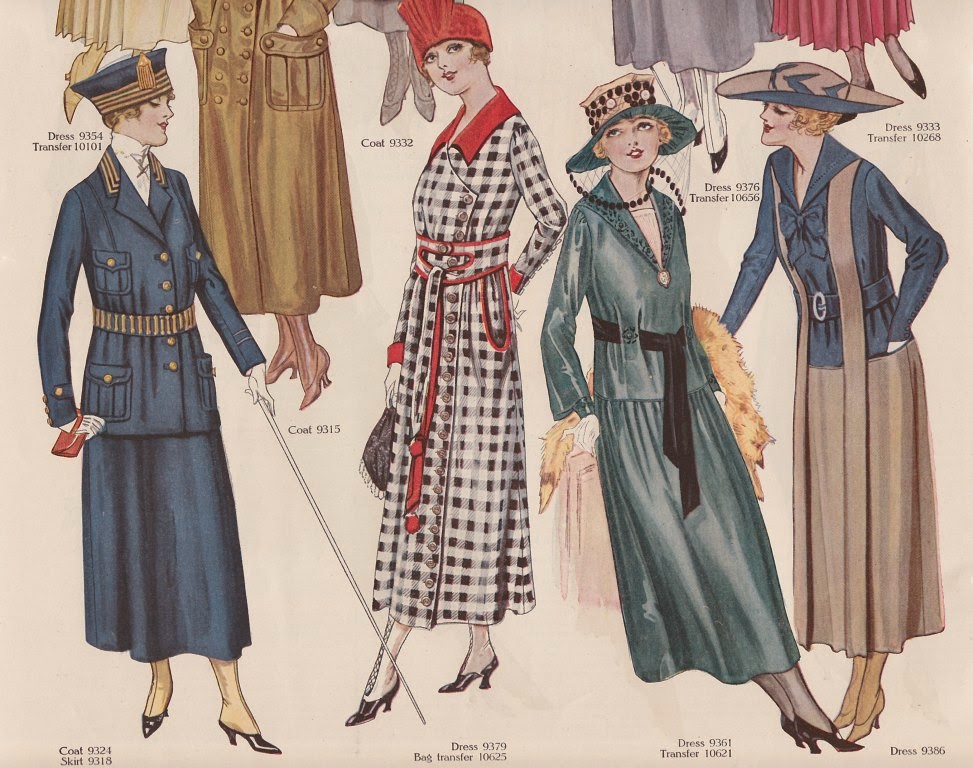
Fashion Forecast: September 1917

What was the well-dressed young woman wearing in September 1917?

According to the cover of this month’s The Delineator, “The New Factors in National Life have Produced New Fashions. The Dress of To-day is Simple. It is also Smart and more than ever Expresses the Spirit of Youth.” I think you’ll notice that this month’s styles are less fussy...but what an interesting note about “the Spirit of Youth.” Commercial obsession with youth is not a modern phenomenon!


In keeping with “the new factors in national life,” The Delineator includes an article on “War Ways of Making New Clothes From Old.” Among the suggestions: changing collars on old dresses, taking advantage of the narrower silhouettes of current style to re-shape old dresses, and using the current fashion for adding panels of different fabrics to dresses to smarten up last year’s frocks.


Always instructive to see are what goes on under the fashions. Undergarments were at a changing point, as both corsets (for the waist and hips) and brassieres (or “bust confiners”) were in use. And yes, in 1917, even articles on lingerie have a militaristic flavor: note the title, First Line Defense of the Figure!:


And now, the styles. The barrel silhouette is still in, but waists are dropping (foreshadowing of the waistless twenties). Prints seem to be out, and ornamentation limited to embroidery details and buttons:


Military-inspired styles of course are in...and at right is possibly one of the made-over colorblock styles mentioned above:

 
Also popular this month are blouses (known at this time as “shirt-waists” or just “waists”) and skirts, probably because it’s much easier for a busy mom working on her victory garden or sewing for the Red Cross to launder a waist than it is a dress:


More “at home” fashions:


And a look at clothes for teens:


Note the young lady at left knitting!:


A quick look at clothes for little girls...


And little boys:


And one last note: all of The Delineator’s covers were charming, and this one’s no exception...but one thing sets it apart. The artist was Maud Humphrey, whom you’ve probably never heard of but was a well-known commercial artist of her day. Perhaps you’re more familiar with her son, Humphrey Bogart? ☺

Friday, September 12, 2014

Happy Bloggy Birthday!

More cake all around!  You'll notice mine isn't nearly as symmetrical as Marissa's, but it will taste just as good, I promise!

As Marissa said, this week marks the beginning of our eighth year blogging.  Can’t believe it!  Blogs start out with little baby steps, and before you know it, they’re all grown up!

But, we hope, never old. 

And that’s why we need your suggestions.  I love what’s been mentioned so far.  Please chime in with more.  Are there other authors you wish we’d feature?  We haven’t had the delightful Cara King on in a while with a Young Bluestockings Attend the Cinema.  Should we watch another flick together?  And I know Marissa and I are planning to attend a couple of writers conferences in the next few months.  Do you like when we cover what we learned?

As for me, I have some ideas of what I’ll be discussing in the next year.  Most of my books coming out in 2015 will be set in post-Civil War Seattle, so I have some interesting tidbits to share on my research.  I’d also like to do a series on resources online that help readers navigate stories set in the 19th century, things like maps, costume collections, and period guides to London.  Plus I thought you might find it interesting to know more about the various awards and bestseller lists out there--how a book earns a place on them and what that placement means.  And my wonderful critique partner says I have to share my book triage method--how to weed out those wonderful books that keep piling up all over your house.  I recently had to put it to use in getting ready to move.

So, what else do you want to know?  How else can we delight you?  This is your chance--make your voice count.

Thanks for playing with us through another year.  You are what keeps us going.  Happy birthday!